


14 Oct What Toxicology Testing Reveals During Recovery: Using Longitudinal Toxicology Data to Better Understand and Support Individual Recovery Journeys
Summary
In this longitudinal analysis of patients receiving OUD care, patient-level fentanyl detection decreased during the first year, as did detection of any evaluated drug and concurrent detection of multiple drug classes. However, a smaller subgroup continued to demonstrate persistent or recurrent detection.
These findings support interpreting toxicology results longitudinally rather than as isolated positive or negative events. Serial results can provide additional context for evaluating changing patterns of substance exposure over the course of treatment. The analysis is observational and cannot establish that treatment or testing caused the observed reductions.
Clinical Takeaway
Longitudinal toxicology testing can complement clinical assessment by providing objective information about recent substance exposure and medication adherence. Serial results may help clinicians recognize improvement, persistence, recurrence, and changing patterns of substance exposure and incorporate these findings into individualized treatment and monitoring decisions.
Background: Recovery is a Longitudinal, Not Necessarily Linear, Process
Substance use disorders (SUD), including opioid use disorder (OUD), may require ongoing assessment and management over time rather than treatment limited to a single episode. Longitudinal research demonstrates substance use trajectories can include periods of improvement, persistence, recurrence, and re-engagement with treatment. National epidemiologic data demonstrates substantial variability in recovery trajectories among individuals with a history of SUD.1-2 For OUD specifically, longitudinal studies demonstrate opioid use often decreases following treatment initiation, although patterns of use may vary among individuals over subsequent months and years.3
This concept is also reflected in current addiction treatment guidance. The ASAM Criteria, 4th Edition, includes Long-Term Remission Monitoring and incorporates recovery management checkups and rapid re-engagement when clinically indicated.4
Implications on Longitudinal Testing in OUD
A reduction in substance use during treatment is clinically meaningful, but a decrease in detected drug use should not necessarily be interpreted as elimination of risk. Rather, longitudinal information can help clinicians distinguish between sustained improvement, persistent exposure, and recurrence after improvement.
SAMHSA’s TIP 63 describes ongoing clinical monitoring, including urine or oral fluid drug testing, as part of OUD treatment. Testing can assist with monitoring medication adherence, assessing treatment response, identifying ongoing substance use, and detecting return to illicit opioid or other substance use. Testing frequency should be individualized according to clinical circumstances rather than based on a fixed schedule.5
ASAM’s drug testing guidance similarly emphasizes toxicology testing provides information about recent substance exposure and should be used to support treatment monitoring. Results should be interpreted in conjunction with the patient’s history, examination, and psychosocial assessment rather than in isolation.6
Aegis Longitudinal Testing Data
Study Population
- Fentanyl analysis: 554 patients; 7,692 specimens
- Polydrug analysis: 393 patients; 5,498 specimens
- Mean specimens/patient: 13.9–14.0
- Median specimens/patient: 12
- Range: 5–36 specimens/patient
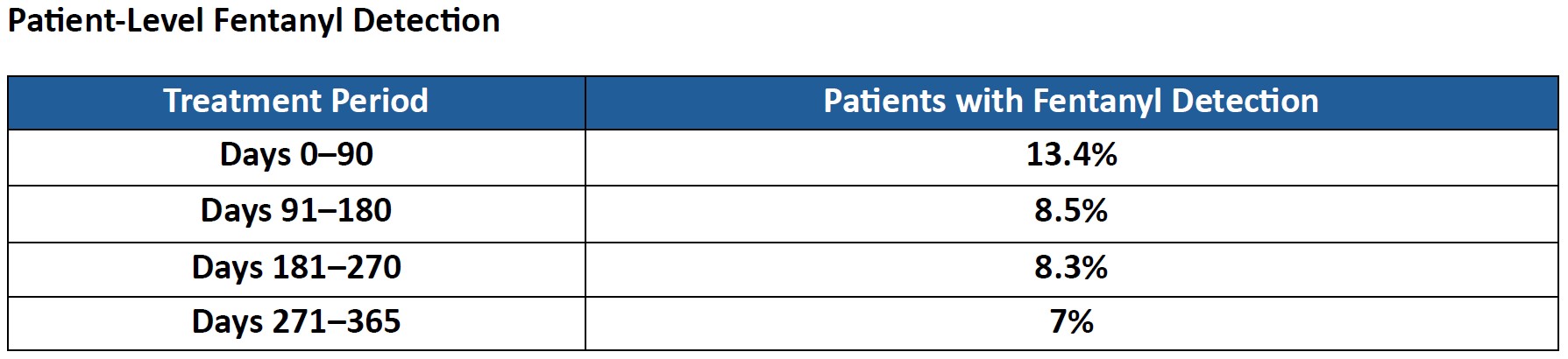
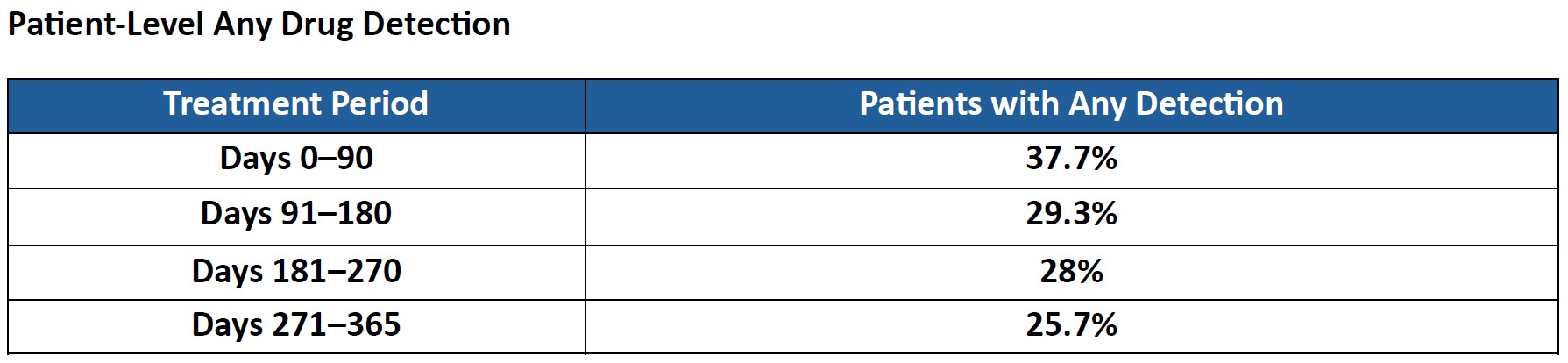
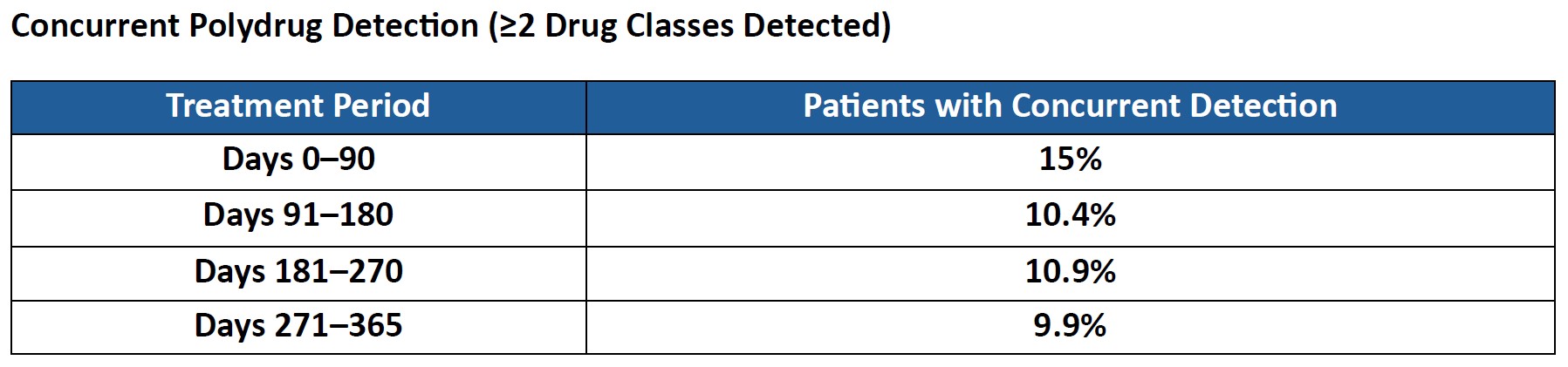
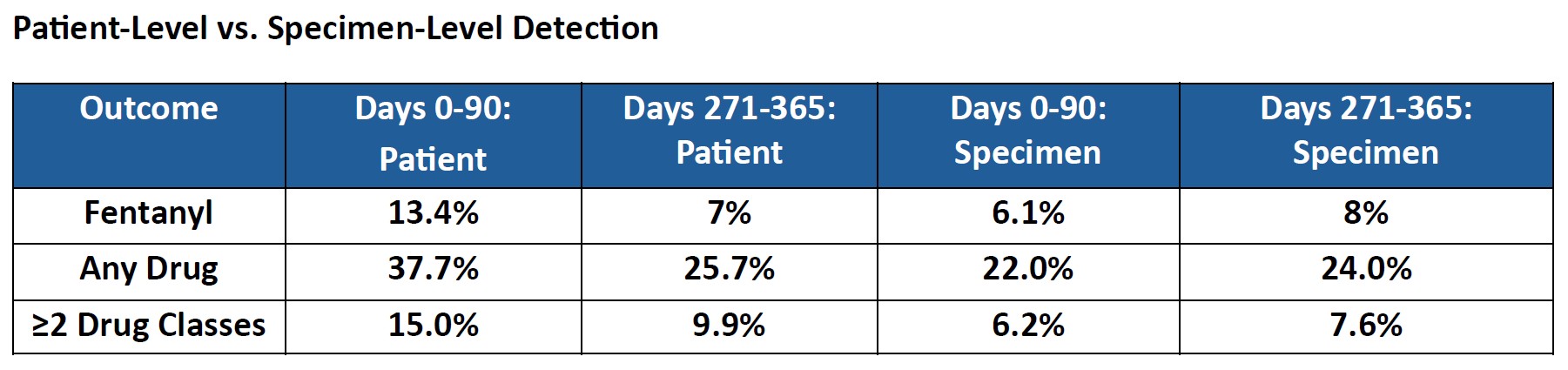
Among 554 patients with OUD, patient-level fentanyl detection declined from 13.4% in days 0–90 to 7% in days 271–365, while a smaller subgroup continued to demonstrate persistent or recurrent detection. In the polydrug cohort, any drug detection declined from 37.7% to 25.7%, and concurrent detection of ≥2 drug classes declined from 15% to 9.9%. These are observational findings and cannot establish treatment and/or testing itself caused the reductions.
Overall, this represents a 6.3 percentage point absolute reduction and an approximately 47% relative reduction from the first to the final treatment period. The overall difference across the four periods was statistically significant (Cochran’s Q = 42.8, p < 0.001). The largest change occurred between the first and second periods, when 34 patients changed from fentanyl detected to not detected, compared with 7 who changed from not detected to detected.
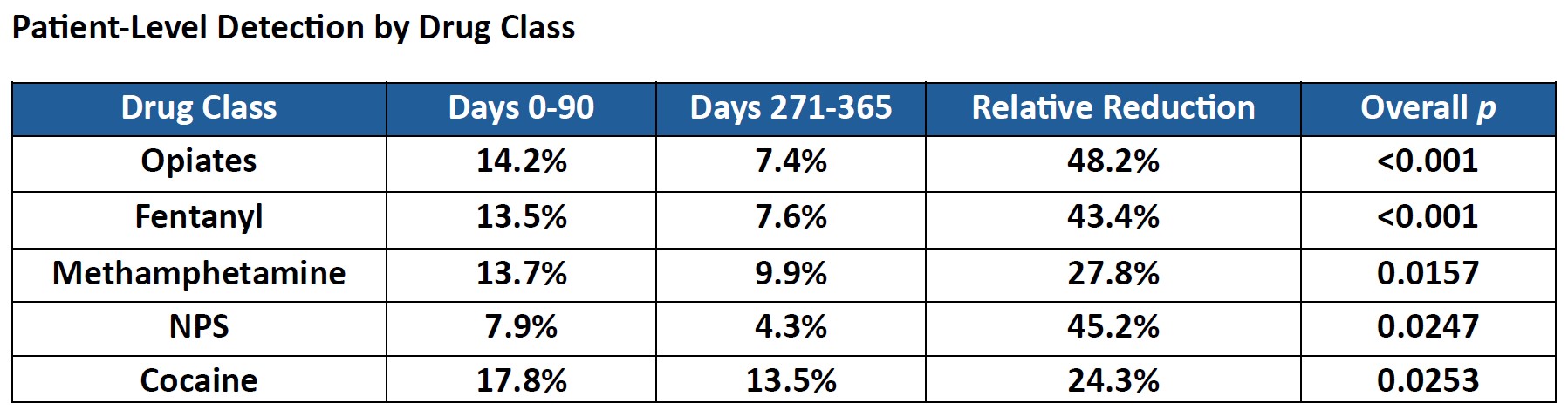
The same general pattern was observed when a broader range of substances was evaluated. The polydrug analysis considered detection of fentanyl, opiates/opioids, methamphetamine, cocaine, and novel psychoactive substances (NPS).
Importantly, the reduction was not attributable to a single drug class. Patient-level detection decreased across all five evaluated classes:
- Opiates: 14.2% → 7.4%
- Fentanyl: 13.5% → 7.6%
- Methamphetamine: 13.7% → 9.9%
- NPS: 7.9% → 4.3%
- Cocaine: 17.8% → 13.5%
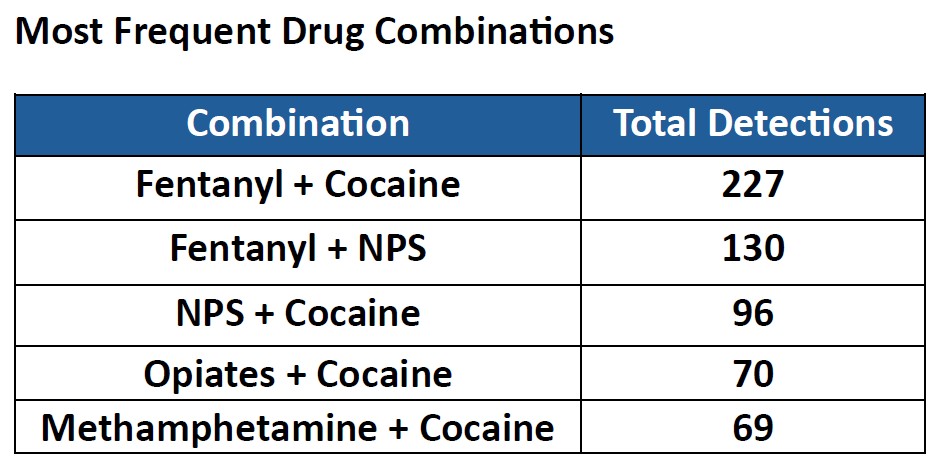
Although overall detection declined, concurrent detection of multiple drug classes persisted in a subset of patients. The proportion of patients with detection of two or more drug classes during a treatment period decreased from 15% during days 0–90 to 9.9% during days 271–365. The overall difference was statistically significant (Cochran’s Q = 15.21, p = 0.002). The drug combinations observed most frequently across the dataset included:
- Fentanyl + cocaine
- Fentanyl + NPS
- NPS + cocaine
- Opiates + cocaine
- Methamphetamine + cocaine
This finding is clinically relevant because aggregate improvements can coexist with a smaller group of patients who continue to experience substantial or recurring substance exposure.
Clinical Interpretation
A single toxicology result provides a snapshot of recent exposure. Repeated testing over time can provide a trajectory.
For example, a patient may demonstrate:
- continued negative results after treatment initiation;
- an initial positive result followed by sustained negative results;
- intermittent recurrence after a period of improvement;
- persistent detection across multiple treatment periods; or
- detection of multiple substances that change over time.
These patterns can provide different clinical information than simply categorizing a patient as “positive” or “negative” at a single point in time.
Aegis longitudinal analysis illustrates this distinction. Although fewer patients demonstrated fentanyl detection as treatment progressed, a smaller group continued to account for a disproportionate number of positive specimens. In the fentanyl cohort, the 10 patients with the most positive specimens accounted for 38.5% of all fentanyl-positive specimens, demonstrating why specimen-level and patient-level analyses can tell different stories.
NOTICE: The information above is intended as a resource for health care providers. Providers should use their independent medical judgment based on the clinical needs of the patient when making determinations of who to test, what medications to test, testing frequency, and the type of testing to conduct.
References:
- McCabe, S. E., West, B. T., Strobbe, S., & Boyd, C. J. (2018). Persistence/recurrence of and remission from DSM-5 substance use disorders in the United States: Substance-specific and substance-aggregated correlates. Journal of Substance Abuse Treatment, 93, 38–48
- Fishman, M., Vo, H. T., Burgower, R., Ruggiero, M., Rotrosen, J., Lee, J., & Nunes, E. (2020). Treatment trajectories during and after a medication trial for opioid use disorder: Moving from research as usual to treatment as usual. Journal of Addiction Medicine, 14(4), 331–336.
- Hser, Y.-I., Huang, D., Saxon, A. J., Woody, G., Moskowitz, A. L., Matthews, A. G., & Ling, W. (2017). Distinctive trajectories of opioid use over an extended follow-up of patients in a multisite trial on buprenorphine + naloxone and methadone. Journal of Addiction Medicine, 11(1), 63–69.
- American Society of Addiction Medicine. (2023). The ASAM criteria: Treatment criteria for addictive, substance-related, and co-occurring conditions (4th ed.). American Society of Addiction Medicine.
- Substance Abuse and Mental Health Services Administration. (2024). TIP 63: Medications for opioid use disorder (PEP24-02-01-006). U.S. Department of Health and Human Services.
- Jarvis, M., Williams, J., Hurford, M., Lindsay, D., Lincoln, P., Giles, L., Luongo, P., & Safarian, T. (2017). Appropriate use of drug testing in clinical addiction medicine. Journal of Addiction Medicine, 11(3), 163–173.
